Your cart is currently empty...
but it doesn't have to be!
We Think You'll Love This


In This Article:
- What Is Beryl? The Mineral Family You Already Love
- Meet the Beryl Family: Every Variety and What Makes It Special
- The Beryl Meaning: What All Varieties Share
- "Which Beryl Variety Matches Your Energy?" Quick Finder
- How Does Beryl Compare Across Varieties?
- 5 Creative Ways to Use Beryl in Your Practice
- When and How to Care for Your Beryl
- How to Spot Genuine Beryl vs Fake
- Natural Beryl vs Synthetic: What's the Difference?
- A Few Things Worth Knowing About Beryl
What Is Beryl? The Mineral Family You Already Love
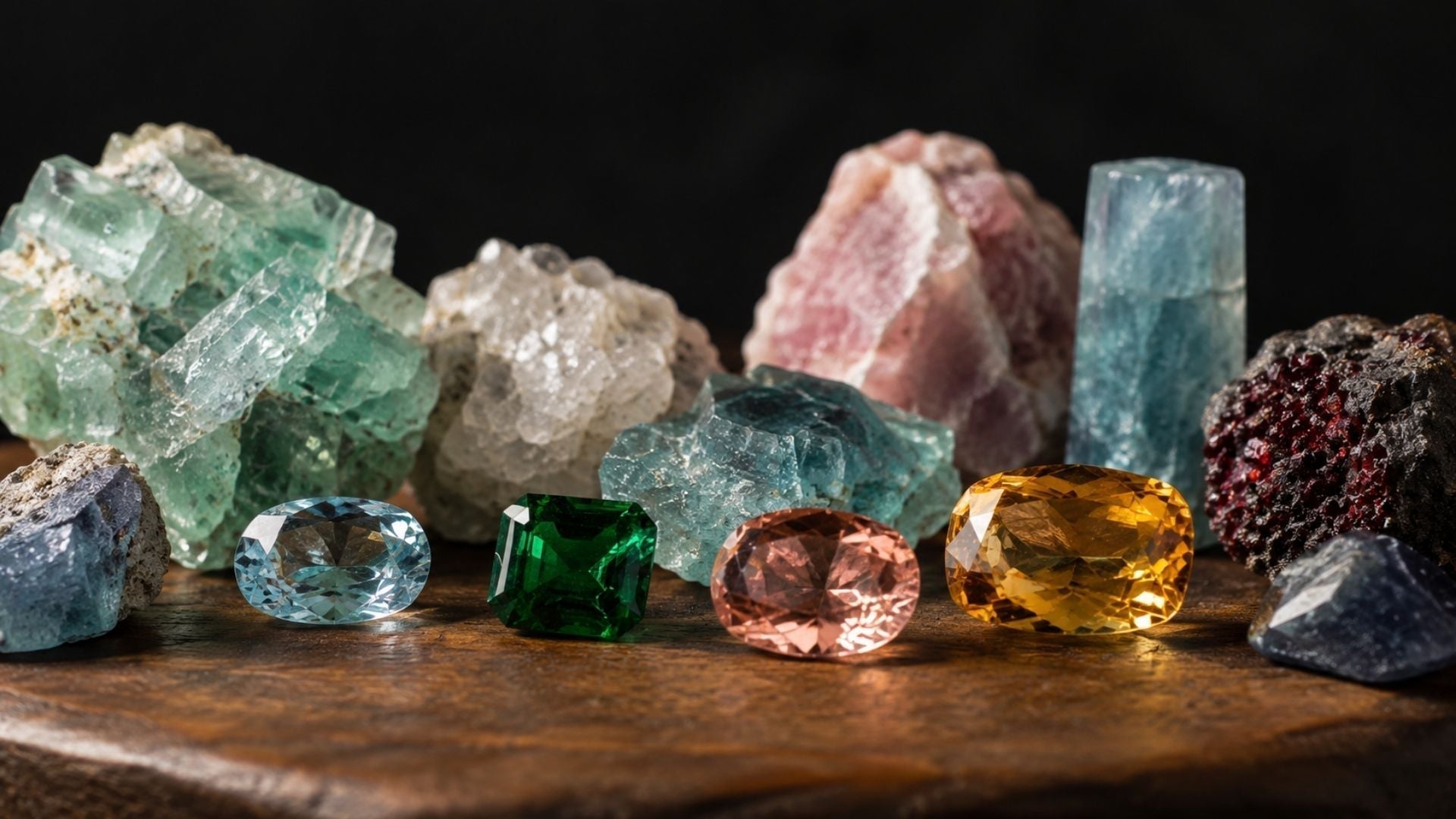
Here's something that surprises most people: some of the world's most famous gemstones are all the same mineral. Beryl is a beryllium aluminum silicate (Be₃Al₂Si₆O₁₈) that forms in hexagonal crystal structures deep within the Earth. On its own, pure Beryl is actually colorless. But add tiny trace elements during formation, and that's where the magic happens:
- Add chromium or vanadium → you get Emerald (green)
- Add iron (Fe²⁺) → you get Aquamarine (blue)
- Add manganese → you get Morganite (pink)
- Add iron (Fe³⁺) → you get Heliodor (golden yellow)
- Add manganese + cesium → you get Red Beryl (red, extremely rare)
- No trace elements → you get Goshenite (colorless)
According to the Gemological Institute of America, Beryl has been one of the most important gemstone families in human history. Emeralds alone have been treasured for over 4,000 years, and Aquamarine has been a sailor's talisman since ancient Roman times.
Here's the quick breakdown:
- Mineral: Beryl (beryllium aluminum silicate)
- Mohs hardness: 7.5 to 8 (durable for jewelry)
- Colors: Green, blue, pink, yellow, red, colorless (depends on variety)
- Found in: Colombia, Brazil, Zambia, Pakistan, Madagascar, USA, Russia
- Chakras: Varies by color (Heart, Throat, Crown, Solar Plexus)
- Crystal system: Hexagonal

Meet the Beryl Family: Every Variety and What Makes It Special
Think of Beryl as the parent, and each colored variety as a child with its own personality. Here's the complete family:
Emerald (The Famous One)
- Color: Vivid green to deep blue-green
- Trace element: Chromium and/or vanadium
-
Chakra: Heart
Best known for: Love, prosperity, emotional healing, and royalty. Cleopatra's favorite stone. One of the four precious gemstones alongside Diamond, Ruby, and Sapphire.
Fun fact: Emerald inclusions are called "jardin" (French for garden) because they look like tiny frozen landscapes inside the stone.
Aquamarine (The Ocean Stone)
- Color: Pale blue to deep blue-green
- Trace element: Iron (Fe²⁺)
-
Chakra: Throat
Best known for: Communication, calm, courage, and protection during travel. Ancient sailors believed it could calm storms at sea.
Fun fact: The name comes from Latin aqua marina, meaning "water of the sea."
Morganite (The Heart Healer)
- Color: Soft pink to peach
- Trace element: Manganese
-
Chakra: Heart
Best known for: Unconditional love, emotional healing, compassion, and divine feminine energy. It's become one of the most popular engagement ring stones in recent years.
Fun fact: Named after banker and gem collector J.P. Morgan in 1911.
Heliodor (The Golden Beryl)
- Color: Golden yellow to greenish-yellow
- Trace element: Iron (Fe³⁺)
-
Chakra: Solar Plexus
Best known for: Confidence, willpower, optimism, and mental clarity. Often called "the stone of the sun."
Fun fact: The name comes from Greek helios (sun) + doron (gift), literally meaning "gift of the sun."
Red Beryl (The Ultra-Rare One)
- Color: Deep raspberry red
- Trace element: Manganese + cesium
-
Chakra: Root and Heart
Best known for: Passion, vitality, and grounding energy. One of the rarest gemstones on Earth, found almost exclusively in Utah, USA.
Fun fact: Red Beryl is estimated to be 1,000 times rarer than Diamond. Gem-quality specimens can command over $10,000 per carat.
Goshenite (The Pure One)
- Color: Colorless
- Trace element: None (pure Beryl!)
-
Chakra: Crown
Best known for: Clarity, truth, purity, and spiritual connection. Historically used as a lens material before glass was developed.
Fun fact: Named after Goshen, Massachusetts, where it was first discovered.

The Beryl Meaning: What All Varieties Share
While each Beryl variety has its own unique energy, the Beryl family as a whole carries certain universal meanings and properties. Understanding these helps you see the common thread running through every stone in the family.
Universal Beryl Symbolism
1. Clarity and truth
Every Beryl variety, from Emerald to Goshenite, is associated with seeing things clearly and honestly. Beryl has been called "the seer's stone" in various traditions because it's believed to sharpen perception and reveal what's been hidden.
2. Emotional balance
Whether it's Morganite soothing the heart or Aquamarine calming the mind, all Beryl varieties share a reputation for bringing emotional stability. They help you feel your feelings without being overwhelmed by them.
3. Courage and confidence
From Emerald's connection to prosperity and leadership to Heliodor's solar confidence, Beryl as a family supports bold, heart-centered action.
4. Protection
Ancient cultures around the world used various Beryl stones as protective talismans. Sailors carried Aquamarine, royalty wore Emerald, and travelers kept Beryl close for safe passage.
The Healing Properties of Beryl
Because Beryl spans so many colors and chakras, its healing properties are uniquely versatile. Here's how practitioners traditionally work with Beryl energy:
Emotional Healing
Beryl in all its forms is traditionally believed to support emotional processing and release. The specific focus depends on the variety:
For heart healing → Emerald and Morganite (Heart Chakra)
For emotional calm → Aquamarine ( Throat Chakra)
For emotional confidence → Heliodor (Solar Plexus)
For emotional grounding → Red Beryl (Root Chakra)
For emotional clarity → Goshenite (Crown Chakra)
Mental Clarity and Focus
Beryl is traditionally associated with clearing mental fog and supporting sharp, focused thinking. This is especially true of Aquamarine (for communication clarity), Heliodor (for confident decision-making), and Goshenite (for pure, unbiased perception).
Spiritual Growth
Beryl's connection to clarity and truth makes it a powerful meditation companion. Many practitioners use different Beryl varieties for different stages of spiritual development:
Goshenite → connecting to pure spiritual truth
Aquamarine → expressing spiritual insights clearly
Emerald → grounding spiritual wisdom in the heart
Morganite → opening to divine love and compassion
Important note: Crystals are a beautiful complement to wellness, but they should never replace professional medical or mental health care.

"Which Beryl Variety Matches Your Energy?" Quick Finder
Not sure which member of the Beryl family is right for you? Find your current need below:
| What You Need Most | Your Beryl | Why | Related Collection |
|---|---|---|---|
| Love, abundance, prosperity | Emerald | Opens the Heart Chakra, attracts growth | Heart Chakra Crystals |
| Calm, clear communication | Aquamarine | Activates the Throat Chakra, soothes the mind | Throat Chakra Crystals |
| Emotional healing, self-love | Morganite | Nurtures the heart with gentle, loving energy | Heart Chakra Crystals |
| Confidence, willpower, clarity | Heliodor | Fires up the Solar Plexus with solar energy | Solar Plexus Chakra Crystals |
| Passion, vitality, grounding | Red Beryl | Anchors the Root Chakra with rare, intense energy | Root Chakra Crystals |
| Spiritual purity, truth | Goshenite | Connects the Crown Chakra to universal wisdom | Crown Chakra Crystals |
Still unsure? Go with Aquamarine or Emerald. They're the two most versatile and accessible members of the Beryl family.
How Does Beryl Compare Across Varieties?
Here's how the main Beryl varieties stack up against each other:
By rarity (rarest to most common):
Red Beryl → Emerald → Heliodor → Morganite → Aquamarine → Goshenite
By price (highest to most affordable):
Red Beryl→ Emerald → Morganite → Aquamarine → Heliodor → Goshenite
By chakra (root to crown):
Red Beryl (Root Chakra Crystals) → Heliodor (Solar Plexus Chakra Crystals) → Emerald (Heart Chakra Crystals) → Morganite (Heart Chakra Crystals) → Aquamarine (Throat Chakra Crystals) → Goshenite (Crown Chakra Crystals)
Key insight: All Beryl varieties share the same Mohs hardness (7.5 to 8) and crystal structure. The ONLY difference between them is the trace elements that create their color. Same family, same durability, completely different personalities.
5 Creative Ways to Use Beryl in Your Practice
1. The Beryl Rainbow Meditation
Collect one stone from each Beryl variety you can access (even just two or three works!). Lay them out in front of you during meditation. Start with the darkest color and work your way to the lightest, spending a few breaths with each stone. This "Beryl rainbow" meditation is believed to activate multiple chakras in sequence.
2. Match Your Beryl to Your Day
Before you leave the house, check in with yourself. Need confidence? Grab Heliodor. Need calm communication? Reach for Aquamarine. Big meeting? Emerald. This daily Beryl check-in helps you start working with crystal energy intuitively instead of overthinking it.
3. The Beryl Pair Technique
Choose two Beryl varieties that complement each other:
Emerald + Aquamarine → Heart opening + clear communication (perfect for difficult conversations)
Morganite + Goshenite → Heart healing + spiritual clarity (ideal for meditation)
Heliodor + Emerald → Confidence + abundance (great for career intentions)
4. Beryl in Your Space
Place different Beryl varieties in different rooms based on what each space needs:
Bedroom → Morganite for love and gentle dreams
Workspace → Emerald or Heliodor for abundance and focus
Living room → Aquamarine for calm, peaceful family energy
5. The Birthday Beryl Connection
Match your birth month to a Beryl variety:
May birthday? → Emerald is your birthstone
March birthday? → Aquamarine is your birthstone
October birthday? → Morganite is sometimes used as an alternative birthstone

When and How to Care for Your Beryl
Instead of a fixed schedule, let the stone tell you when it needs attention:
Cleanse your Beryl when...
- It feels heavier than usual in your hand
- You've worn it during a stressful or emotional day
- Someone else has handled it
- It's been sitting untouched for a while
- You're starting a new intention or chapter
Best methods by variety:
| Variety | Best Cleanse | Best Recharge | Avoid |
|---|---|---|---|
| Emerald | Moonlight or smoke | Moonlight or earth burial | Ultrasonic, steam |
| Aquamarine | Selenite or sound | Moonlight | Prolonged sunlight |
| Morganite | Smoke or sound | Moonlight only | ANY sunlight (fades!) |
| Heliodor | Warm soapy water | Short sunlight (1-2 hrs) | Harsh chemicals |
| Goshenite | Any gentle method | Moonlight or clusters | Extreme heat |
How to Spot Genuine Beryl vs Fake
Whether you're buying Emerald, Aquamarine, or any other Beryl variety, knowing how to identify the real thing matters:
Signs of genuine Beryl:
- Natural color variation and inclusions (especially in Emerald)
- Feels cool and smooth to the touch
- Has appropriate weight for its size
- Comes with certification or source documentation
Signs it might be fake:
- Color is unnaturally bright or perfectly uniform
- Stone is completely flawless (most natural Beryl has some inclusions)
- No certification and suspiciously low pricing
- Glass or synthetic imitations feel lighter and lack depth
Natural Beryl vs Synthetic: What's the Difference?
Synthetic Beryl (especially synthetic Emerald and Aquamarine) exists and is widely available:
Natural Beryl → formed over millions of years underground, contains natural inclusions, carries the energetic properties crystal practitioners value, certified by gemological labs
Synthetic Beryl → created in a laboratory with the same chemical composition, often appears "too perfect," significantly cheaper, chemically identical but lacks the geological history many practitioners believe gives natural stones their energy
A Few Things Worth Knowing About Beryl
Whether you're new to Beryl or a longtime collector, keep these in mind:
✅Beryl is the mineral family behind Emerald, Aquamarine, Morganite, and more
✅All Beryl varieties rate 7.5 to 8 on the Mohs scale, durable for everyday wear
✅Red Beryl is 1,000 times rarer than Diamond




















 Mindful Points


 60 Seconds
 5 Questions


