Your cart is currently empty...
but it doesn't have to be!
We Think You'll Love This


In This Article:
- What Is Howlite?
- The Mineral Facts Most Howlite Guides Skip
- Howlite Crystal Meaning: The Stone of Awareness
- Howlite Benefits and Healing Properties
- Which Calming Crystal Do You Actually Need?
- Which Chakra Is Howlite?
- Howlite Versus Turquoise
- Howlite Versus Magnesite
- Three Ways to Check What You Bought
- Is Dyed Howlite Still Real?
- How to Use Howlite Crystal
- Can Howlite Go in Water?
- How to Cleanse and Charge Howlite
- What Crystals Pair Well With Howlite?
- Who Should Wear Howlite?
- The Takeaway
- About Mindful Souls
What Is Howlite?
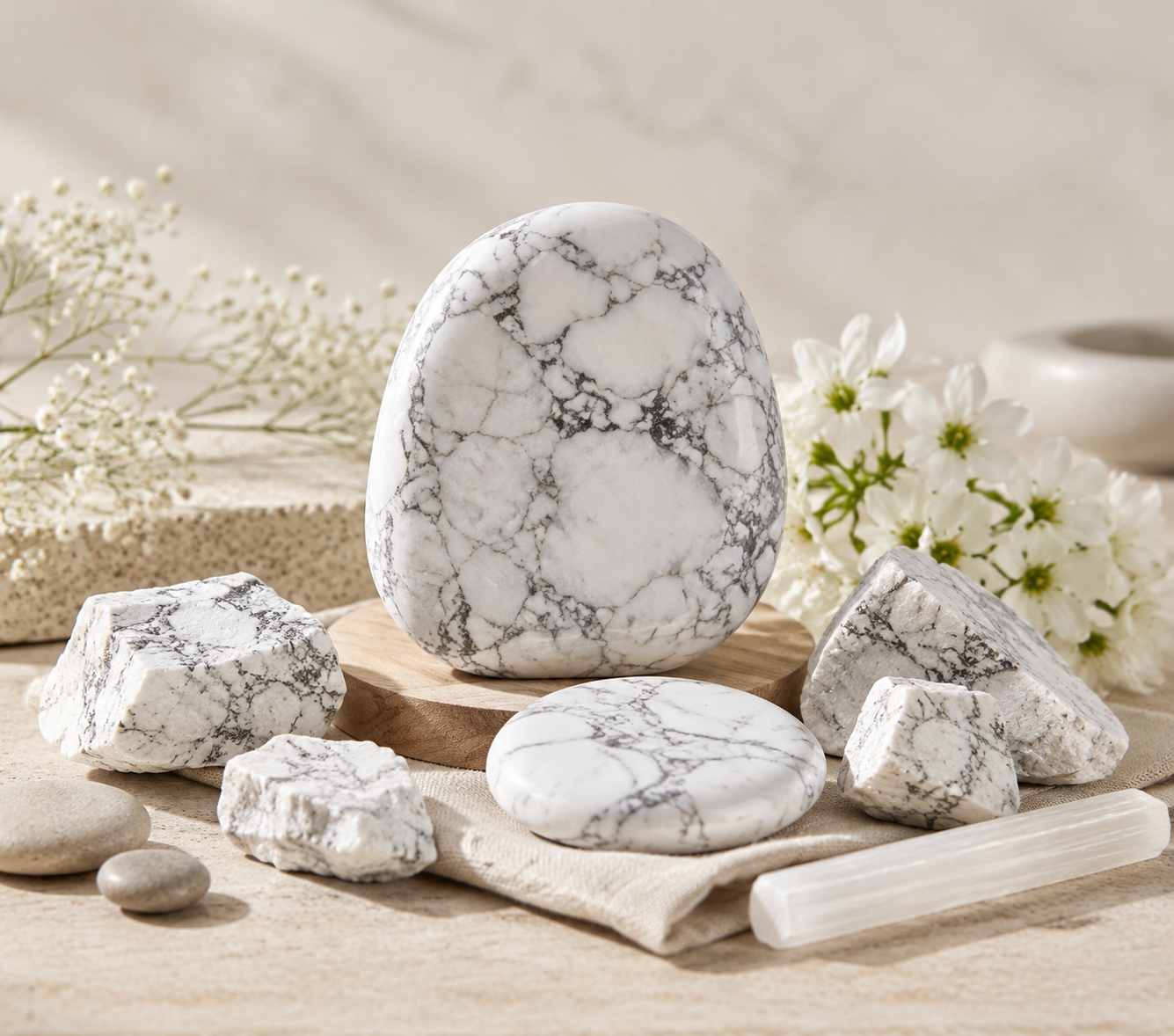
Howlite is a soft, porous white mineral with dark web-like veining, discovered in 1868 by Canadian chemist Henry How. Classified as a borate mineral, it rates just 3.5 on the Mohs hardness scale. In crystal tradition it is known as the Stone of Awareness, valued for calm, patience, and quieting mental noise.
Henry How was a professor of chemistry at King's College in Windsor, Nova Scotia. Miners at a nearby gypsum quarry complained to him about a stubborn white mineral that kept blunting their tools. He analysed it, found it was something science had not catalogued, and originally called it silico-boro-calcite. The name howlite came later, given in his honour by the American mineralogist James Dwight Dana.
That origin story is oddly fitting. Howlite entered the record as the thing that slowed everything down.

The Mineral Facts Most Howlite Guides Skip
Nearly every howlite page online repeats the same short list: white, veined, soft, calming. Here is what usually gets left out, and why each detail matters once you own a piece.
| Property | Chemical Formula | Ca₂B₅SiO₉(OH)₅ |
|---|---|---|
| Mineral Class | Borate containing silicon (silicoborate) | |
| Crystal System | Monoclinic | |
| Mohs Hardness | 3.5 | |
| Specific Gravity | Approximately 2.5, noticeably light for its size | |
| Type Locality | Windsor, Hants County, Nova Scotia, Canada | |
| Main Commercial Source | Tick Canyon, Los Angeles County, California | |
| Lustre | Dull to sub-vitreous, often described as porcelain-like | |
Almost nobody has seen a howlite crystal. This is the fact that surprises collectors. Howlite is sold everywhere as a "crystal," but well-formed, transparent howlite crystals are genuinely rare and mostly of interest to mineral collectors. Virtually all howlite on the consumer market is the massive nodular form, meaning irregular lumps rather than geometric crystals. If a seller advertises a howlite "point" or "tower," that shape was cut and polished from a nodule, not grown.
Most of it comes from California, not Canada. Nova Scotia is where howlite was first identified, which is why it appears in every article. The bulk of what reaches the bead and tumble market today comes from Southern California, with additional material from Turkey, Russia, Mexico, and Germany.
3.5 on the Mohs scale is softer than it sounds. Numbers alone mean little, so here are the reference points. A fingernail sits around 2.5. A copper coin sits around 3.5, the same as howlite. A steel knife blade is around 5.5, and quartz is 7. This means almost every other stone in a typical crystal collection will scratch howlite, and howlite is only one step above the hardness of your own fingernail.
Its porosity is the reason for everything else. Howlite behaves like unglazed ceramic. That single property explains why it takes dye so completely, why water damages it, why it absorbs body oils and perfume, and why it became the cheapest convincing turquoise substitute on the market.

Howlite Crystal Meaning: The Stone of Awareness
Howlite carries two traditional names, and the difference between them is worth understanding.
As the Stone of Awareness, it is associated with noticing: catching a reaction before it becomes a response, hearing your own thoughts clearly enough to question them.
As the Stone of Patience, it is associated with the pause that follows. Not suppressing frustration, but taking the extra beat before acting on it.
Put together, the traditional howlite meaning is less about calm as a mood and more about calm as a skill. It is a stone associated with the gap between feeling something and doing something about it, which is why it comes up so often in practices around anger, reactivity, and overthinking rather than simple relaxation.
That framing tends to land differently at 50 than it does at 25. The people who gravitate to howlite are often not looking to feel excited about anything. They are looking to stop carrying the day into the night.
Howlite Benefits and Healing Properties
Crystal properties come from spiritual tradition and personal practice rather than proven medical effect. Howlite is a natural mineral with real physical characteristics; its energetic meanings are cultural. With that said, here is what it is traditionally used for.
For Stress and an Overactive Mind
This is howlite's signature association. It is traditionally kept close during periods of mental overload, the sort where you are functioning fine on the outside while a background process runs constantly. Many people keep a tumbled piece on a desk or in a pocket precisely because touching something cool and solid interrupts the loop.
For Sleep
Howlite is one of the most commonly recommended sleep crystals, usually placed on a nightstand or under a pillow. The tradition connects it to slowing racing thoughts at bedtime rather than sedation. If your sleep trouble is the thinking kind rather than the tired kind, that distinction matters, and it is worth reading why stress may not be the whole story behind insomnia before you blame it for everything.
For Anger and Reactivity
Among calming stones, howlite is specifically linked to diffusing anger, both your own and the tension you absorb from others. It is traditionally suggested for people who tend to hold irritation quietly rather than express it, which is where it earns its patience reputation.
For Patience and Emotional Balance
Longer term, howlite is associated with tolerance: sitting with delay, ambiguity, or people who move slower than you would like. Pair it with a stone like lepidolite if anxiety is the dominant thread, or celestite if you want something gentler still.
For Meditation and Mindfulness
Because howlite is associated with awareness rather than energy, it suits meditation and journaling more than manifestation work. Holding a piece gives restless hands somewhere to go, which is often the practical obstacle for beginners.
Which Calming Crystal Do You Actually Need?
"Calming" covers a lot of different problems. This is how howlite compares to the stones it is most often shelved beside.
| If Your Problem Is | Traditional Choice | Why |
|---|---|---|
| Thoughts that won't stop at night | Howlite | Traditionally linked to mental quiet rather than sedation. |
| Anxiety with a physical edge | Lepidolite | Associated with emotional overwhelm and easing nervous tension. |
| Difficulty falling asleep generally | Amethyst | A long-standing bedtime crystal in many spiritual traditions. |
| Struggling to say the hard thing | Blue Lace Agate | Connected with the throat chakra and calm, thoughtful communication. |
| Grief or a hard season | Kunzite | Associated with gentleness, compassion, and heart-centered healing. |
Howlite appears twice because it is the most specific of the group. It is not a general soother. It is traditionally aimed at the noise between your ears and what that noise makes you do.
Which Chakra Is Howlite?
Natural white howlite is primarily associated with the Crown Chakra, connected to awareness, perspective, and mental stillness, with a secondary link to the Third Eye. Dyed blue howlite is commonly associated with the Throat Chakra instead, since that connection comes from its colour rather than the mineral.
This is a point where a lot of guides contradict each other, and the reason is simple. White and blue howlite are not treated the same way.
Natural white sits with the Crown, the centre associated with clarity and higher perspective, which fits a stone about stepping back from your own thoughts.
Dyed blue howlite is usually placed with the Throat Chakra, because throat associations in crystal practice are colour led. If communication is your intention, blue is the traditional choice. If mental quiet is, stay with white.

Howlite Versus Turquoise
Howlite and turquoise are entirely different minerals. Because howlite is porous and inexpensive, it is frequently dyed blue and sold as imitation turquoise, sometimes under the trade name "turquenite." Genuine turquoise is a rarer copper mineral with a much higher price. "White turquoise" is a marketing term, not a real gemstone.
This is the single most common point of confusion, and it costs people money.
Natural turquoise is a copper-bearing mineral, naturally blue to green, and genuinely scarce. Howlite is naturally white, abundant, and soft, which makes it the perfect candidate for dye.
Price is the loudest tell. Natural howlite pieces typically run from a couple of dollars to around twenty-five. Turquoise of comparable size and quality costs many times that. Turquoise at a howlite price is howlite.
Howlite Versus Magnesite
This comparison gets far less coverage than the turquoise one, and it probably affects more purchases.
A significant share of white veined beads sold as howlite are actually magnesite. The two look strikingly similar and are used interchangeably across the bead trade, often without anyone intending to deceive.
They are chemically unrelated. Magnesite is magnesium carbonate. Howlite is a borate. The practical difference is that magnesite, being a carbonate, reacts to acid and will fizz, while howlite does not. That is how a gemmologist tells them apart in seconds. It is also a destructive test that damages the stone, so it is worth knowing why sellers can distinguish them and you usually cannot.
By eye, magnesite tends toward finer, tighter, more net-like veining and a smoother surface. Howlite veining is typically bolder and more irregular, sometimes almost sketched-looking. Neither is superior, and their traditional meanings overlap heavily. It is simply worth knowing that "howlite" in the bead world is a loose category.
Three Ways to Check What You Bought
1. The weight test. Howlite is light for its size, with a specific gravity around 2.5. A piece that feels dense or cold in the way glass does is worth a second look.
2. The vein test. On dyed pieces, colour concentrates in the veins first, because the porous channels absorb dye fastest. Look for a piece where the veining reads darker or more saturated than the body colour. Genuine turquoise usually shows the opposite pattern, with matrix veining that is a different material entirely rather than a deeper shade of the same colour.
3. The acetone test. Dye on howlite often lifts with a cotton bud dipped in acetone or nail polish remover. Test on an inconspicuous spot, such as the underside of a bead or the base of a carving. Colour transferring onto the cotton means the piece is dyed. No transfer is not proof of natural colour, since some dyes are more stubborn, but transfer is proof of dye.
A chip or scratch also often reveals white underneath on dyed material. The same broad logic applies across stones, and our guide to spotting fake amber walks through the mindset in more detail.
Is Dyed Howlite Still Real?
Yes, and this deserves a straight answer, because people worry about it.
Dyed blue howlite is real howlite. The mineral is genuine; only the colour was added. In crystal practice, most people treat dyed pieces as spiritually valid, working with the stone's own properties plus whatever the colour represents to them.
Where it stops being acceptable is the labelling. A dyed piece sold honestly as blue howlite is fine. The same piece sold as turquoise is not. Ask, and buy from sellers who tell you before you have to.
One practical note on dyed pieces. New dyed howlite can occasionally transfer a trace of colour onto skin or light fabric, particularly if it gets damp. This settles with time and is not a sign of a fake, but it is worth knowing before you wear a new blue howlite bracelet under a white sleeve.
How to Use Howlite Crystal
Quick answer: Keep howlite where your mind gets loudest: a nightstand for sleep, a desk for focus, or a pocket for daily use. Hold it during meditation, place it near your pillow at night, or wear it as a bracelet so it stays in contact through the day.
- On the nightstand for bedtime overthinking. This is the practical default, and there is a physical reason to prefer it over sleeping with the stone against skin, covered below.
- On a desk as a physical anchor. Reach for the stone instead of your phone when attention drifts.
- In a pocket or bag so it is available before a difficult conversation.
- In the hand during meditation, paired with a focal object like a Buddha figure if you like a set space.
- As a bracelet or necklace for continuous contact, which is why howlite is so common in beaded jewellery.
For placement at home, howlite is traditionally kept in bedrooms and quiet corners rather than active rooms. It is a wind-down stone, not an energising one.
Can Howlite Go in Water?
No. Howlite is soft at 3.5 on the Mohs scale and porous, so water can dull its surface, weaken the stone, and lift dye from coloured pieces. Never soak it, and remove howlite jewellery before showering, swimming, or washing up.
Treat howlite as you would unglazed pottery. Salt water is worse than fresh. Dyed pieces are the most vulnerable of all, since colour can bleed.
Wipe it with a dry, soft cloth. That is genuinely all the physical cleaning it needs.
The care problem nobody mentions
Porosity does not only apply to water. Howlite absorbs body oils, hand cream, perfume, sunscreen, and hairspray. On a white stone worn daily, this shows. Pieces that started bright white often turn faintly cream or grey along the areas that sit against skin, and once absorbed, it does not wipe off.
Two habits prevent most of it. Put jewellery on last, after lotion and fragrance have dried. And give howlite its own soft pouch rather than a shared box, because at 3.5 on the Mohs scale nearly every other stone you own will scratch it.
This is also why the nightstand beats sleeping with a piece against skin. A full night of contact with slightly salty, slightly acidic sweat is harder on a porous stone than a day of ordinary wear.

How to Cleanse and Charge Howlite
Since water is off the table, use dry methods.
To cleanse: sound from a bell or singing bowl, brief smoke cleansing, moonlight on a windowsill, or resting it on a selenite plate overnight. A desert rose selenite piece works nicely for this and looks good doing it.
To charge: hold the stone, take a few slow breaths, and name what you want it to represent. Moonlight is the traditional pairing for howlite. It is gentle, and it avoids the direct sunlight that fades dyed stones.
How often? After anything emotionally heavy, or roughly monthly with regular use. There is no rule; go by whether it still feels like yours. If your crystals never seem to click, these common mistakes that block crystal energy are worth a look. And if you would rather skip maintenance entirely, blue kyanite never needs cleansing at all.
What Crystals Pair Well With Howlite?
Howlite is quiet enough to pair with almost anything. The most useful combinations:
- Howlite and Amethyst for sleep, the classic bedtime pair. An amethyst tumbled stone on the nightstand alongside howlite is the simplest version.
- Howlite and Lepidolite for anxiety and emotional overwhelm.
- Howlite and Blue Lace Agate for calm communication, particularly with blue howlite.
- Howlite and Black Tourmaline when you want calm plus boundaries.
- Howlite and Kunzite for softness after a hard season.
One physical caution on pairing. Storing howlite loose against harder stones is how it gets scratched, and black tourmaline, amethyst, and quartz are all considerably harder. Pair them in practice, separate them in the drawer.
Who Should Wear Howlite?
Howlite is traditionally linked with Gemini and Virgo, both signs associated with fast, analytical, sometimes over-busy thinking. That said, zodiac matching is a starting point, not a rule, and no crystal is off limits based on your birthday. If you are curious how those associations work, our zodiac crystal guide covers the traditional pairings.
Howlite is also a strong first stone. It is affordable, widely available, easy to recognise, and its purpose is simple to explain, which is more than can be said for many beginner crystals.
It is not a birthstone for any month.
The Takeaway
Howlite will not change your life. What it does, in the tradition that surrounds it, is give a very ordinary intention a physical home: slow down, notice, wait a beat.
For a stone that costs very little and asks only that you keep it away from water, lotion, and harder crystals, that is a reasonable trade. Start with one tumbled piece on the nightstand. If it earns its place there, build from there.
About Mindful Souls
Mindful Souls started in 2018 with a simple idea: to make crystals and spiritual practices feel more accessible in everyday life. Today, we're a community of over 180,000 people exploring these tools in a practical, personal way.
We carefully source all of our crystals directly from ethical suppliers around the world, ensuring they are 100% natural. Each one is also tested and third-party lab certified for authenticity and quality, so you always know what you're working with. If you're curious about how it all started, you can read more on our story page.
















 Mindful Points
 Wishlist
 Contact Us


 60 Seconds
 5 Questions


