Your cart is currently empty...
but it doesn't have to be!
We Think You'll Love This


In This Article:
- What Is Amethyst Crystal?
- Amethyst Crystal Properties at a Glance
- Amethyst's Colour Zoning and Varieties
- What Does Amethyst Mean?
- What Are the Amethyst Properties and Benefits?
- Does Amethyst Crystal Really Work?
- Which Chakra Is Amethyst Connected To?
- Is Amethyst the February Birthstone?
- What Are the Different Types of Amethyst?
- How Is Amethyst Different From Other Purple Crystals?
- How Do You Use Amethyst Crystal in Daily Life?
- Where Should You Place Amethyst Crystal at Home?
- How Do You Cleanse, Charge and Care for Amethyst?
- How Can You Tell If Amethyst Is Real?
- How Do You Choose a Good Amethyst Crystal?
- Common Mistakes to Avoid
- Key Takeaways
- Conclusion
- About Mindful Souls
What Is Amethyst Crystal?
Amethyst is the purple form of quartz, a mineral made of silicon dioxide. It scores 7 on the Mohs hardness scale, so it holds up well to daily life. You will find it in every shade from soft lilac to deep, almost inky purple.
It is part of the same big family as clear quartz, smoky quartz and citrine. If you enjoy the quartz family, take a look at our quartz jewelry and crystals or the clear quartz collection.
Why Is Amethyst Purple?
The purple comes from tiny traces of iron locked inside the quartz. Over time, natural radiation from the surrounding rock changes that iron, and the crystal turns violet.
That little bit of chemistry explains two things people are often surprised by:
- Heat changes the color. Heat amethyst and it can turn golden yellow. A lot of the citrine you see in stores started life as amethyst.
- Sunlight fades it. Leave amethyst in a bright window for months and the purple slowly softens.
How Is Amethyst Formed?
Most amethyst grows inside gas bubbles trapped in cooling lava. Mineral rich water trickles into those hollow pockets, and over millions of years crystals build up from the walls inward. Crack one of those pockets open and you have a geode. Amethyst also forms in cracks in the rock where hot fluids move through, called hydrothermal veins.
Where Does Amethyst Come From?
- Brazil: big geodes and tall "cathedrals", usually a lighter purple
- Uruguay: rich, dark purple with small, tightly packed crystals
- Zambia: deep purple material cut into jewelry
- Mexico: Vera Cruz and Guerrero amethyst, clear and pale
- Namibia: Brandberg amethyst, with phantoms and smoky zones
- Canada: Thunder Bay amethyst, often with red hematite tips
- United States: the Four Peaks mine in Arizona
- Russia: historic dark purple stones from the Ural Mountains
Amethyst Crystal Properties at a Glance
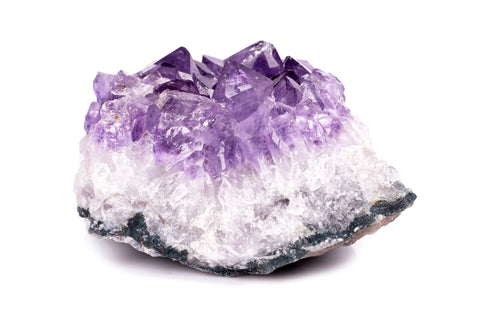
Amethyst is purple quartz with a hardness of 7. Iron and natural radiation give it its color, heat can turn it yellow and sunlight can fade it. It grows in volcanic pockets and comes mostly from Brazil, Uruguay, Zambia, Mexico and Namibia.
|
|
|
| Chemichal Classification | Quartz Group |
| Composition | Silicon Dioxide |
| Chemical formula | SiO2 |
| Origin | Found globally, with significant deposits in Sri Lanka, Brazil, Uruguay, Madagascar, and Russia. |
| Weight | Typically dense |
| Hardness on Mohs | 7 |
| Transparency Level | Transparent to translucent |
| Texture | Smooth, vitreous luster |
| Inclusions | Crystals, liquid inclusions, fractures, hematite needles |
| Colors | Light lavender to deep Purple |
| Colors Zoning | Common |
| Light interaction | Pleochroism |
| Fluorence | Weak (in some specimens) |
Characteristics of Amethyst Chemichal Classification Composition Chemical formula Origin Weight Hardness on Mohs Transparency Level Texture Inclusions Colors Colors Zoning Light interaction Fluorence Weak (in some specimens)

Amethyst's Colour Zoning and Varieties
The lovely purple stone, found from Siberia to Sri Lanka and Brazil to Uruguay, varies by source. The top grade, "Deep Siberian" Amethyst, features a primary purple hue of 75-80%, 15-20% blue, and secondary red hues.
Its colors range from deep purple to light violet, with secondary reddish-purple or red-and-blue mixes. Here's a closer look at some captivating variations of natural Amethyst---popular types of amethyst collected by enthusiasts:
 Ametrine
What happens when Amethysts interweave with sunny Citrine? Ametrine is born. It's a two-in-one stone that works wonders in sparking creativity and inspiring you when you're feeling stuck or simply... bored.
 Cactus Quartz
This may be the cutest variation. Cactus quartz looks like a little cactus covered in sparkly purple. It is said to bring positive energy and is most powerful when used by people who already have a strong foundation in their relationships.

Canadian or Pink Amethyst
This rare kind of Amethyst has very similar properties to Rose Quartz. Pink Amethyst is found in Canada, and its soft energy is all about spreading love and healing hearts..

Lavender Amethyst
As the name gives away, this variation of Amethyst is known for its gorgeous lavender color. It's lighter than the deep purple Amethyst we all know and is perfect for helping you feel relaxed and clear-headed.

Prasiolite
The Green amethyst, also called prasiolite, mainly comes from Brazil and stirs debate about its origin. Some say it's just heat-treated amethyst turning green, while others claim it's naturally occurring. True prasiolite is rare in nature, leading to confusion about whether it should be called green quartz instead.

Veracruz
Veracruz amethysts grow in holes of volcanic rock, getting their purple from iron and sunlight effects. They often appear with green epidote, in cool shapes that show off their volcanic roots.
What Does Amethyst Mean?
Amethyst means "not intoxicated", from the Greek word amethystos. Over the centuries that idea grew into a wider meaning: a clear mind, self control, peace and spiritual wisdom. It is still what most people are reaching for when they pick up an amethyst today.
Where Does the Name Amethyst Come From?
The ancient Greeks believed amethyst kept them sober. Some drank from amethyst cups or dropped a stone into their wine.
You may have heard the tale of Amethyste, a young woman turned to white stone and then stained purple by the god of wine. It is a lovely story, but here is a fact most articles skip: it was written by the French poet Rémy Belleau in 1576, not by the ancient Greeks.
A Short History of Amethyst
- Ancient Egypt: carved into amulets and beads.
- Greece and Rome: worn for a clear, sober mind.
- Medieval Europe: carried by soldiers for protection and worn in bishops' rings as a sign of devotion.
- Royal treasure: it appears in many royal collections, including the British Crown Jewels.
- The 1800s: amethyst was once priced alongside ruby and sapphire. Then huge deposits turned up in Brazil and it became something almost anyone could own.
What Does Amethyst Symbolize?
Amethyst carries six big ideas:
- Clarity: a sober, focused, wise mind
- Calm: peace when life gets noisy
- Protection: a shield against heavy or negative energy
- Spirituality: a link to something bigger than yourself
- Royalty: dignity and quiet strength, since purple was the color of kings
- Love: steady, sincere, faithful love
Amethyst means "not intoxicated" in Greek. For thousands of years it has stood for clarity, calm, protection and spiritual wisdom, from Egyptian amulets to bishops' rings and royal crowns.
What Are the Amethyst Properties and Benefits?
In crystal traditions, amethyst is used to calm the mind, support a peaceful bedtime, deepen meditation and protect your energy. These benefits come from spiritual practice and personal experience, not from scientific studies. I like to think of amethyst as a companion to your wellbeing habits, not a fix.
Amethyst for Calm and Stress Relief
If there is one job amethyst is famous for, it is helping people slow down. Something as simple as rolling a smooth stone between your fingers on a hectic day can pull you back into the moment. That is why so many people carry a pocket stone into meetings, exams or long drives. Our stress relief collection and peace collection are good places to start.
Amethyst for Sleep and Dreams
Amethyst has been called a sleep stone for generations. People keep it on the nightstand or under the pillow as part of a calm bedtime ritual, and many say it helps them remember gentler dreams. A small cluster or a smooth tumbled stone is ideal. Browse our deep sleep collection.
Amethyst for Meditation and Intuition
Few crystals are used in meditation as often as amethyst. Because it is tied to the third eye, people turn to it when they want to quiet the chatter in their head and listen to their gut. Find pieces for your practice in our meditation collection.
Amethyst as a Protection Stone
Many crystal lovers treat amethyst as a soft shield. The belief is that it takes in heavy energy and turns it into something calmer. You will often see a geode by a front door or a cluster on a work desk for exactly this reason. See our protection collection and negative energy repellents.
Amethyst for Spiritual Growth and Manifestation
Amethyst is a natural fit for intention work: journaling, goal setting or a new moon ritual. Pair it with clear quartz if you like to amplify an intention. Explore our spiritual awakening and manifestation collections.
Does Amethyst Crystal Really Work?
Science has not shown that amethyst heals the body or mind. I would rather be honest with you about that. What amethyst does beautifully is give your intention something you can hold. Each time you touch it, you pause, breathe and refocus, and that small habit can genuinely change how a day feels.
Please never use amethyst instead of medical or mental health care. If you are dealing with anxiety or sleep problems, a professional is the right first call.
Best amethyst form for each benefit:
- Calm: a tumbled stone or bracelet you can hold
- Sleep: a small cluster or tumbled stone by the bed
- Meditation: a point, tower or sphere in front of you
- Protection: a geode or cluster near the door or desk
- Spiritual growth: a point or tower on your journaling desk
Which Chakra Is Amethyst Connected To?
Amethyst is linked to the crown chakra and the third eye chakra. The crown chakra sits at the top of the head and relates to spiritual connection. The third eye sits between the eyebrows and relates to intuition. Both share violet and purple tones, which is why amethyst fits so naturally.
Crown chakra (Sahasrara)
- Location: top of the head
- Theme: spiritual connection and wisdom
- How to use amethyst: place it just above your head while lying down
Third eye chakra (Ajna)
- Location: between the eyebrows
- Theme: intuition and clarity
- How to use amethyst: rest it on your forehead while you meditate
Shop our crown chakra crystals and third eye chakra crystals, or balance all seven with our 7 chakra collection. New to chakras? Read what chakras are.
Is Amethyst the February Birthstone?
Yes, amethyst is the official February birthstone. It is also the traditional gift for a 6th wedding anniversary. If you know someone with a February birthday, it is one of the most meaningful gifts you can give. GIA's February birthstone page has more background, and our birthstones by month guide covers every month.
Amethyst Zodiac Signs
Amethyst belongs most closely to Pisces and Aquarius, the two signs that share February. Dreamy, intuitive Pisces connects with its soft side, while forward thinking Aquarius connects with its clarity. Virgo and Capricorn often use it too, to take the edge off overthinking. Shop the Pisces collection or the Aquarius collection.
-
Amethyst Bead Bracelet
Amethyst Bead Bracelet inspires calm and serenity. In fact, with both protective & cleansing traits, the Amethyst will become your best spiritual ally against any busy mind or worried spirit.
SHOP NOW -
Raw Amethyst Cluster Crystal
Amethyst cluster is a crystal cluster of pure tranquility and spiritual awakening with strong meaning and properties. It's as if a thousand tiny crystal guardians have gathered to create a celestial party, just for you!
SHOP NOW -
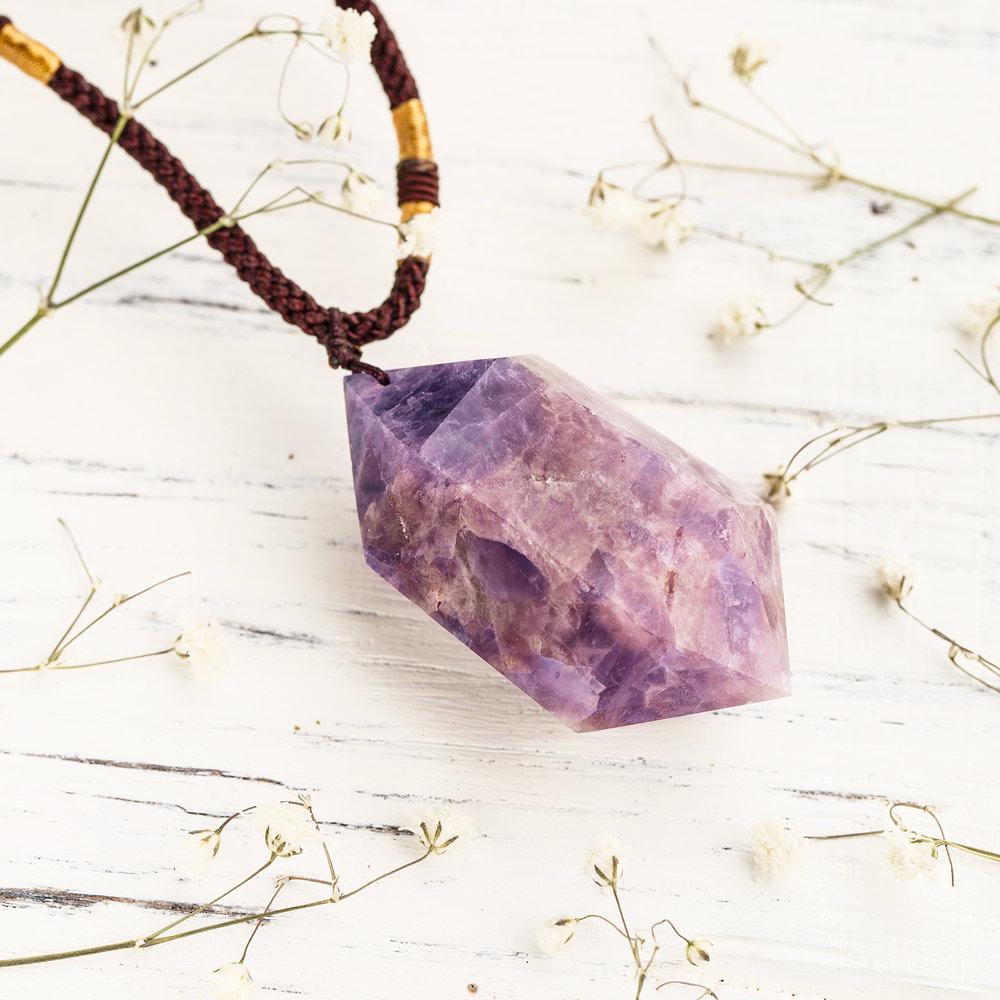
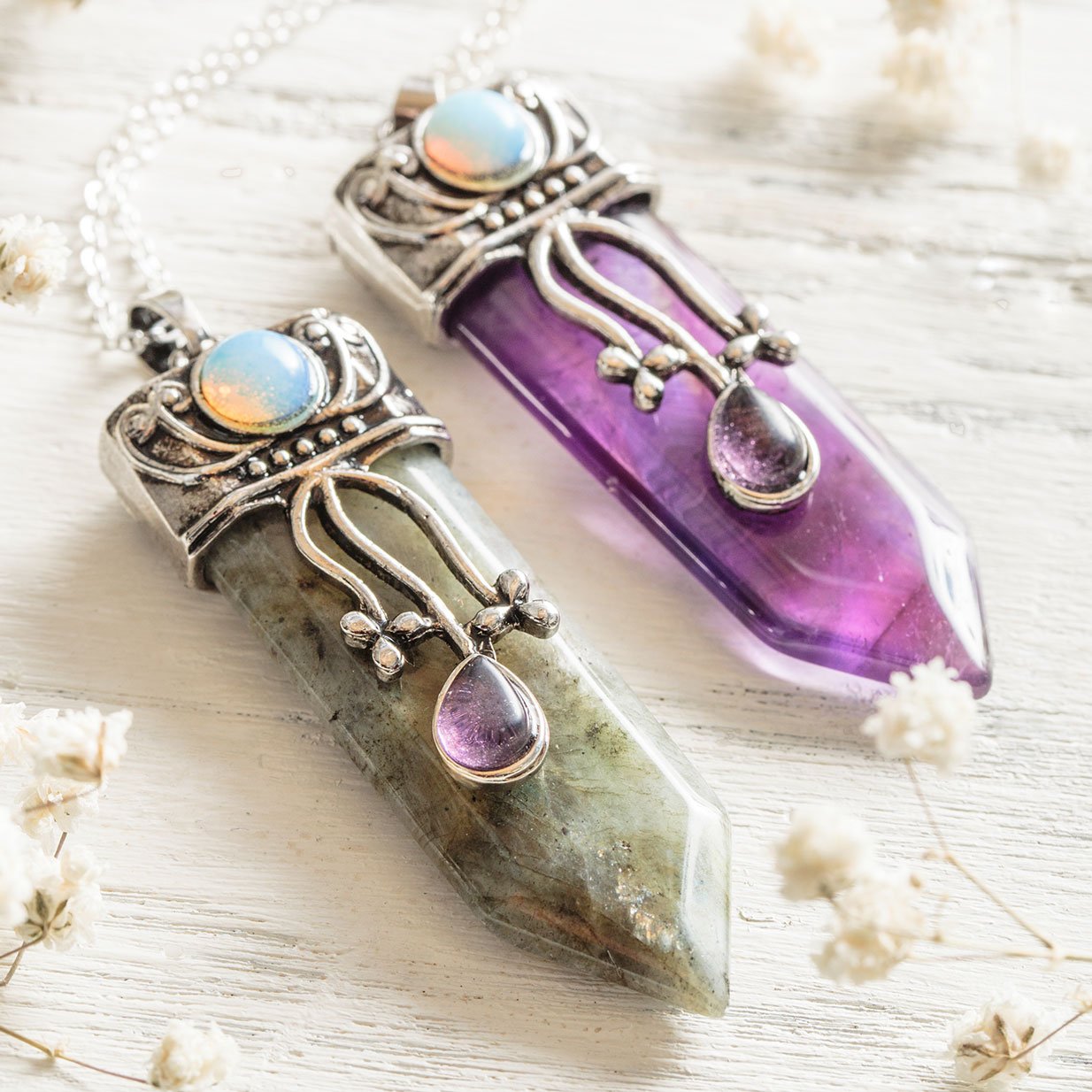
Amethyst Crystal Necklace
Amethyst Necklace will help you bring deeper consciousness and any desired changes in your life!
SHOP NOW

What Are the Different Types of Amethyst?
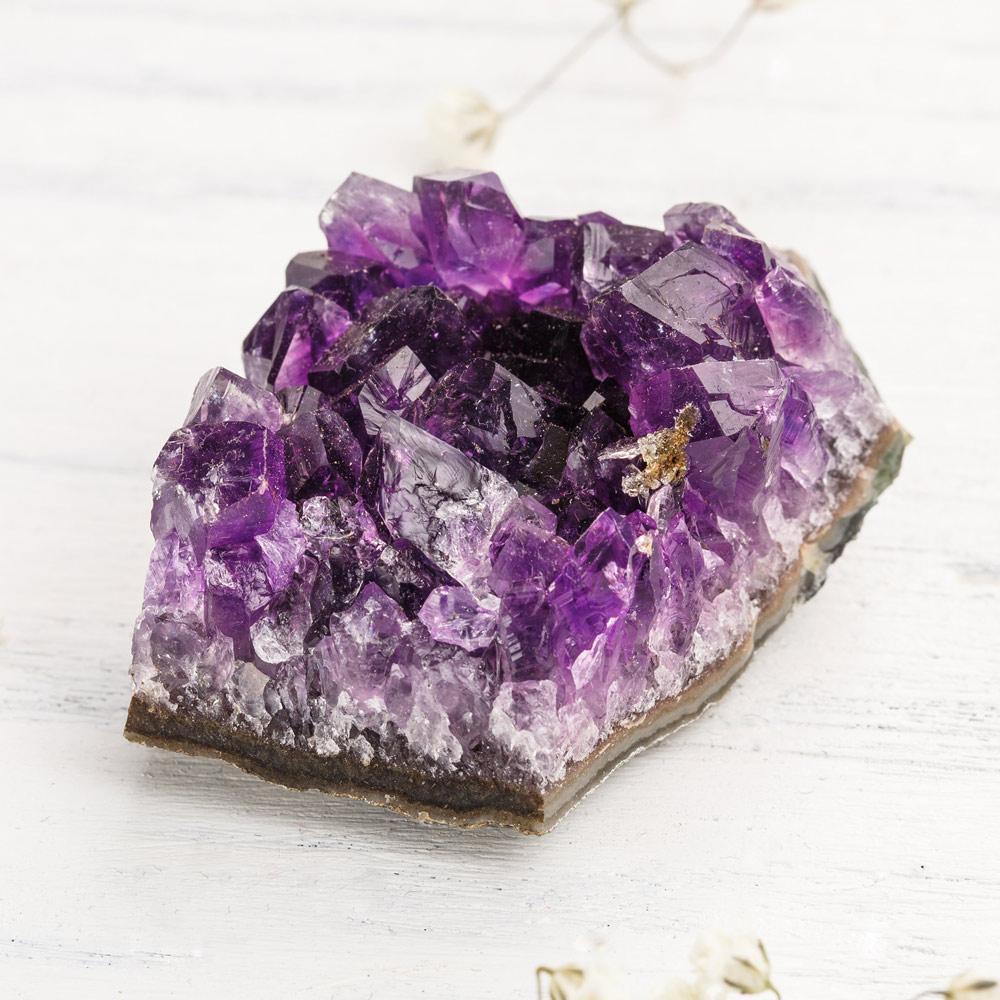
Amethyst comes in several varieties depending on where it grows, its shade and what grows alongside it. Once you learn to spot them, it is hard to stop.
By origin
- Brazilian amethyst: big geodes and cathedrals with lighter purple crystals
- Uruguayan amethyst: deep purple, dense little crystals from Artigas
- Vera Cruz amethyst: clear, pale, slender points from Veracruz, Mexico
- Brandberg amethyst: from Namibia, mixing amethyst, smoky and clear quartz in one crystal
- Thunder Bay amethyst: from Ontario, Canada, with red hematite on the tips
By pattern or color
- Chevron amethyst: V shaped stripes of purple and white quartz
- Lavender amethyst: soft, pale lilac
- Pink amethyst: a rare pink to mauve shade from Patagonia, Argentina
- Green amethyst (prasiolite): pale green, almost always heat treated amethyst
Blends and growth forms
- Ametrine: purple and gold in one stone, from Bolivia
- Cactus (spirit) amethyst: tiny crystals coating a larger point, from South Africa
Love the raw, natural look of these varieties? Browse our raw crystals and clusters and geodes.
How Is Amethyst Different From Other Purple Crystals?
Amethyst is tougher than most purple crystals and far more affordable than purple sapphire. Here is a quick side by side with the stones people mix it up with most.
- Amethyst (quartz, hardness 7): glassy with uneven color zones, affordable and great for everyday jewelry. Linked to calm, intuition and protection.
- Purple fluorite (hardness 4): glassy and often banded, grows in cube shapes. Affordable but scratches easily, so it is better for display. Linked to focus.
- Purple sapphire (corundum, hardness 9): very bright and usually faceted. Durable but expensive. Linked to wisdom and insight.
- Lepidolite (mica, hardness 2.5 to 3): pearly and flaky. Too soft for daily jewelry. Linked to emotional balance.
Curious about fluorite? See our fluorite collection. Deciding between amethyst and rose quartz? Our rose quartz vs amethyst guide breaks it down.
How Do You Use Amethyst Crystal in Daily Life?
Wear it, meditate with it, keep it by your bed or give it a spot in your home. What matters most is using it with a clear intention and keeping it where you will actually see it.
How to Meditate With Amethyst
- Find a quiet spot and hold the amethyst in your left hand.
- Take five slow, deep breaths.
- Choose a short intention, like "I feel calm and clear."
- Rest the stone on your forehead, or keep holding it, for 5 to 10 minutes.
- Close with a moment of thanks.
A singing bowl and a few incense sticks make the ritual feel even more special.
Sleeping With Amethyst
Set a tumbled stone or small cluster on your nightstand, or tuck a smooth polished stone under your pillow. Keep sharp points off the pillow so they do not poke you. It works best alongside a screen free wind down.
Wearing Amethyst Jewelry
Wearing amethyst keeps it with you all day, and its hardness means it copes well with everyday life.
- Bracelet: something to touch whenever you need a reset. See our spiritual bracelets and beaded bracelets.
- Necklace: sits close to the heart and makes a thoughtful gift. Browse our necklaces.
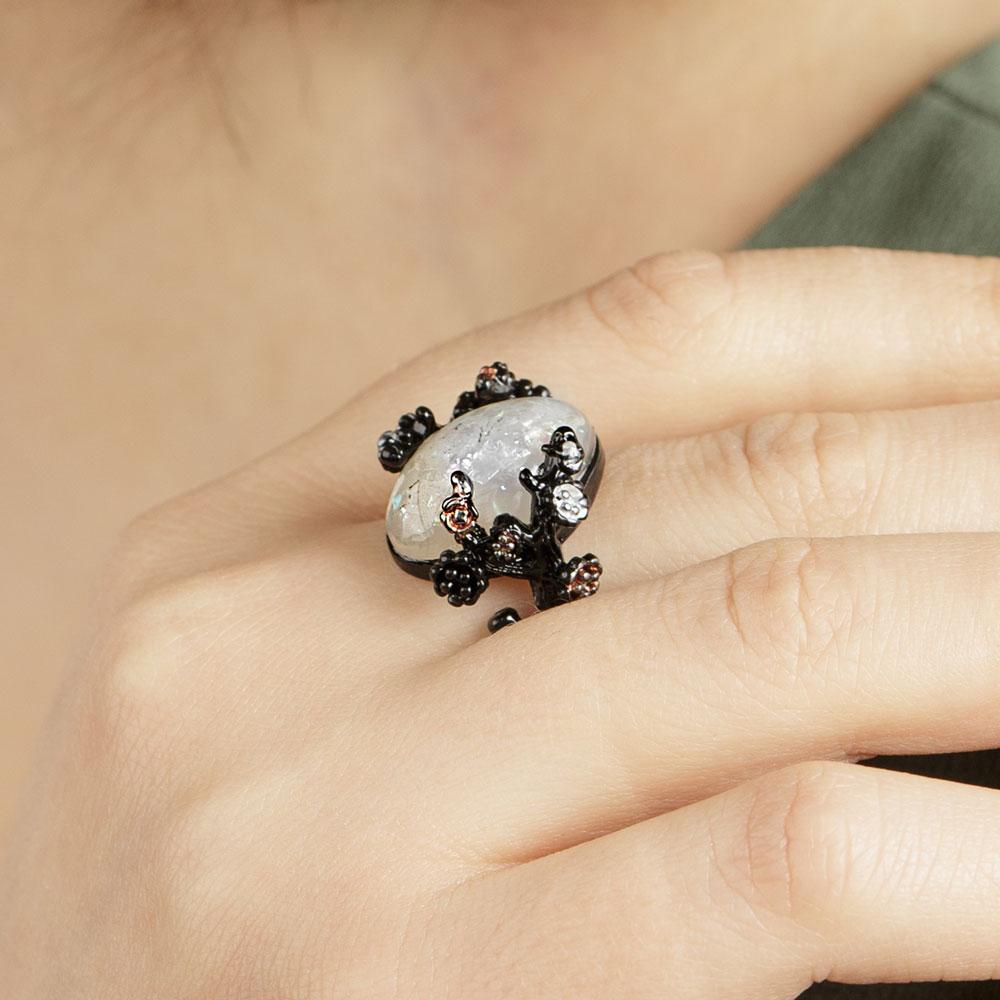
- Ring: a small daily reminder of your intention. Shop crystal rings.
- Earrings: a soft touch of purple near the face. See crystal earrings.
Or head straight to our amethyst jewelry and crystals collection.
A Simple Amethyst Ritual
- Cleanse your amethyst with smudging smoke, sound or moonlight.
- Write one intention on a small piece of paper.
- Place the amethyst on the paper overnight.
- Hold the stone in the morning and read your intention out loud.
- Carry it with you through the day.
Which Amethyst Should You Choose for Your Goal?
| Your Goal | Best Amethyst Form | Where to Shop |
|---|---|---|
| Better sleep | Small cluster or tumbled stone | Deep sleep collection |
| Calm on the go | Bracelet or pocket stone | Amethyst jewelry |
| Home protection | Geode or cluster | Clusters and geodes |
| Meditation | Tower, point or sphere | Crystal towers , crystal spheres |
| Holding in your palm | Palm stone | Crystal palm stones |
| Natural look | Raw amethyst | Raw crystals |
| Starting out | Beginner set | Essentials for beginners , crystal sets |
| A meaningful gift | Necklace, ring or geode | Birthday gifts , gifts for stress relief |
Where Should You Place Amethyst Crystal at Home?
The best spots are the bedroom, your meditation corner, the home office and the entryway. Each one supports a slightly different intention.
- Bedroom nightstand: a small cluster or tumbled stone sets a calm tone for bedtime.
- Meditation corner: a tower, sphere or geode helps you settle and focus.
- Home office or desk: a point, cluster or crystal pyramid encourages clear thinking.
- Entryway: a geode or large cluster makes a protective welcome.
- Living room: a geode or cathedral creates a peaceful shared space.
In feng shui, amethyst often goes in the northeast part of the home, the area tied to knowledge and personal growth. For more ideas, see our feng shui collection and crystal decor.
How Do You Cleanse, Charge and Care for Amethyst?
Give amethyst a quick rinse, moonlight, smoke or sound to cleanse it, and keep it out of strong sun. Once a month is a good rhythm, or sooner after a heavy week.
Can Amethyst Go in Water?
Yes, a short rinse is completely fine. Amethyst is hard quartz and does not dissolve. Run it under lukewarm water and pat it dry with a soft cloth. Skip long soaks for geodes and clusters, because water and salt can weaken the rock they sit on.
Can Amethyst Be in Sunlight?
Not for long. Strong sunlight slowly fades the purple. A few minutes will not hurt, but a sunny windowsill is the worst place to display it. Charge it under moonlight instead.
How to Charge and Activate Amethyst
- Cleanse the stone first.
- Leave it under the full moon overnight, or on a selenite charging plate.
- Hold it and say your intention in a few simple words.
- Keep it where you will use it.
Want more methods? Read our cleansing and charging crystals guide.
How to Store Amethyst
- Keep it in a soft pouch or a lined box.
- Store it away from sunlight and heat.
- Dust clusters and geodes with a soft makeup brush.
- Keep it apart from softer crystals, because amethyst can scratch them.
Safe for amethyst: a quick water rinse, moonlight, smoke from sage or palo santo, sound from a singing bowl and a selenite plate.
Avoid: long soaks for geodes and clusters, salt water, strong sunlight and heat.
How Can You Tell If Amethyst Is Real?
Real amethyst usually has uneven color, small natural inclusions and feels cool in your hand. Glass fakes often look too perfect and may hide tiny round bubbles. For an expensive piece, a gemologist can confirm what you have.
Signs of real amethyst
- Uneven color with visible zones
- Fine natural lines or wisps inside
- Feels cool and warms up slowly in your hand
- Clusters show slightly different shades from crystal to crystal
- A fair price for the size and color, from a seller with clear details
Red flags for fakes
- Perfectly even color all over
- Round air bubbles, a sign of glass
- Warms up quickly in your hand
- Paint or dye pooled at the base of a cluster
- A suspiciously low price or vague product details
One thing worth knowing: lab grown amethyst is real quartz and looks identical to natural amethyst. Only a lab can reliably tell the two apart.
How Do You Choose a Good Amethyst Crystal?
Choose by color, clarity, shape and how open the seller is about the stone. Deep, even purple is usually the most prized, but the best amethyst is simply the one that suits what you want it for.
- Color: deep purple is highly valued, lavender feels softer and gentler.
- Clarity: fewer cracks for jewelry, while inclusions add character to raw pieces.
- Shape: match it to your goal using the table above.
- Size: small pieces for bags and bedrooms, larger geodes for living spaces.
- Price: amethyst price rises with color depth, size, clarity and origin. Deep Uruguayan geodes and Zambian gems usually cost more.
- Seller: buy from shops that tell you the stone type, size and origin.
Browse the full range in our healing crystals collection.
Common Mistakes to Avoid
- Displaying amethyst in a sunny window. The color fades over time.
- Soaking geodes in salt water. It can damage the rock base.
- Trusting perfectly even purple at a rock bottom price. It may be glass or dyed.
- Expecting amethyst to replace medical care. Use it as a mindful support only.
- Storing it with soft stones. It can scratch fluorite and lepidolite.
- Forgetting to cleanse it. A monthly cleanse keeps your practice feeling fresh.
Key Takeaways
- Amethyst crystal meaning centers on calm, clarity, protection and spiritual awareness.
- Amethyst is purple quartz with a Mohs hardness of 7.
- Iron and natural radiation create its color, and sunlight can fade it.
- It connects to the crown and third eye chakras.
- It is the February birthstone and suits Pisces and Aquarius.
- Popular types include Brazilian, Uruguayan, Chevron and Vera Cruz amethyst.
- Rinse briefly, charge under moonlight and keep it away from heat and sun.
- Real amethyst shows color zones and natural inclusions.
- Its benefits come from tradition, not science, so use it as a mindful support.
Conclusion
There is a reason amethyst has stayed popular for thousands of years. It is strong enough to wear every day, gentle enough for a complete beginner, and it carries a story that runs from Greek wine cups to royal crowns. Whether you are after calmer evenings, a steadier meditation practice or a protective piece for your home, amethyst is a wonderful place to begin.
Ready to find yours? Explore our amethyst jewelry and crystals collection, pick a statement piece from our clusters and geodes, or let us surprise you each month with a crystal subscription box.
About Mindful Souls
Mindful Souls started in 2018 with a simple idea: to make crystals and spiritual practices feel more accessible in everyday life. Today, we're a community of over 180,000 people exploring these tools in a practical, personal way.
We carefully source all of our crystals directly from ethical suppliers around the world, ensuring they are 100% natural. Each one is also tested and third-party lab certified for authenticity and quality, so you always know what you're working with. If you're curious about how it all started, you can read more on our story page.















 Mindful Points
 Contact Us


 60 Seconds
 5 Questions


Она позволяет компаниям демонстрировать свою ответственность и заботу о потребителях, повышая уровень доверия и лояльности к бренду. Расскажите как [url=https://airlady.forum24.ru/?1-4-0-00000094-000-0-0-1758539762]сертификат соответствия оформить[/url]
I love the information in these blogs. I feel like I have learned so much from them.
Thank you and God Bless🙏🙏🙏
Luv My Box❤️
I just so happen to come across this article, and didn’t want to stop reading it. I’m so drawn to crystals in so many ways. As I sit beside my Amethyst tree. Happy to have joined the blog.
Thank you for this 💞 blessed be sister and brother 💗.